
Hierarchy Is No Longer Persuasive
Persuasion Intelligence for Leaders
Listen to this article
Hierarchy is no longer persuasive. It may never have been.
An org chart can tell people what to do. It can’t make them want to do it, and it has never had less power to try. Management layers are thinning. Amazon, Google, Intel and Bayer have all cut manager roles or given the managers who remain much larger teams. More work now runs through cross-functional teams, partner organizations, and people who report to someone else. The leader who needs a yes is less and less often the person who writes the review.
The people doing the leading are also running low. Gallup’s latest State of the Global Workplace report found manager engagement fell to 22% in 2025, down nine points since 2022, and it pulled global engagement down with it. Gallup’s own CEO called managers the answer the corporate world has largely overlooked, including on whether AI adoption succeeds or stalls.
In a flatter organization, every initiative is a sale.
That includes rolling out a new AI workflow, getting another department to prioritize your project, and keeping a stretched team committed through its third reorganization in two years. None of it moves on authority alone. It moves when people decide it’s worth their effort, and people decide the same way buyers do.
In a flatter organization, every initiative is a sale.
The Answer Was Never in the Title
Organizations have watched the same thing happen for decades. Two managers have the same training and the same mandate. One builds a team people compete to join. The other gets compliance and quiet turnover. The usual explanation is charisma.
My father, Russ Granger, spent his career refusing to accept that explanation. What he found applies as much to leading as to selling. The difference lies in what the other person’s brain needs in order to decide, and whether the leader delivers it.
The neuroscience behind this is well established. Antonio Damasio studied patients with damage to the brain regions that connect emotion to reasoning. They could analyze their options at length, yet they struggled to make even simple decisions. Without emotion, logic doesn’t reach a conclusion.
Facts inform. Logic justifies. Emotion decides.
Lincoln understood this long before anyone could explain how a brain works. “If you would win a man to your cause,” he told an audience in 1842, “first convince him that you are his sincere friend.”

Commitment Is a Decision
Most leadership development teaches the mechanics: setting goals, delegating, running meetings, giving feedback, managing change. These matter. But they describe the leader’s process, not the other person’s decision to take ownership.
Directing work means assigning tasks and tracking them. That can get you compliance. But what you actually need is collaboration, contribution, and commitment, and you can’t assign any of those. Each one requires a decision by the people you lead, whether they’re direct reports, peers, or partners. Without that decision, you get what’s now called quiet quitting: people doing exactly what’s required, and nothing more.
Compliance only requires that people understand the instruction. Commitment requires that they want to participate in the outcome. Wanting isn’t reasoned into existence; it’s decided, the same way every buying decision is. That’s what makes leadership a persuasion job. Your work is to create the conditions under which people choose to commit.
Direction may yield compliance. Commitment takes persuasion.
That gap is why a well-built change plan can still stall in the hallway. Gartner’s research finds that only about a third of leaders get employees to adopt change in a healthy way. The plan was sound. The people never decided they wanted it.
Four Steps to Yes, With or Without Authority
The Missing Intelligence Layer
Most leaders know their initiative well, and many know their people well. What’s missing is the organized layer between that knowledge and what they actually say in the kickoff, the one-on-one, or the message announcing the change.
Persuasion intelligence is the missing layer between what you know about your initiative and your people, and what you actually say.
The structure is the same one that works in sales. Your initiative is the offer. You can build its Authority, Contrast, Reciprocity, and Reason Why once and use it with everyone. Each stakeholder is a customer. Their Friendship, Hope, and Consistency triggers are specific to that relationship.
Contrast deserves particular attention in change efforts, because the alternative you’re competing against is usually the status quo.
What high achievers have always done intuitively, your entire leadership team can now do intentionally.
You don't need more leadership training. Just add the intelligence layer that helps produce more commitment.
In Practice
“In today’s corporate environments, you need to cultivate support and buy-in regardless of reporting structure,” said Mike Iandolo, then president of the Wireless Networks Group at Alcatel-Lucent. “Triggers are applicable even if you do have authority, and absolutely essential if you don’t.”
AbbVie’s Managed Care team struggled to get the support it needed from field reps it had no authority over. Through a series of workshops, the team built trigger-based approaches to each of those relationships. Within weeks, access, response times, the content of rep reports and client engagement all improved, followed by measurable gains in product orders.
The Intelligence Already Exists
You don’t need more authority. You need to make better use of what you already know about the people you lead.
A title gets you a hearing. Activating triggers get you a decision.
Put the 7 Triggers to Work for You
Nothing mysterious, no magic bullets. Seven principles grounded in neuroscience, refined through field experience, and applied to the decisions you want to influence.
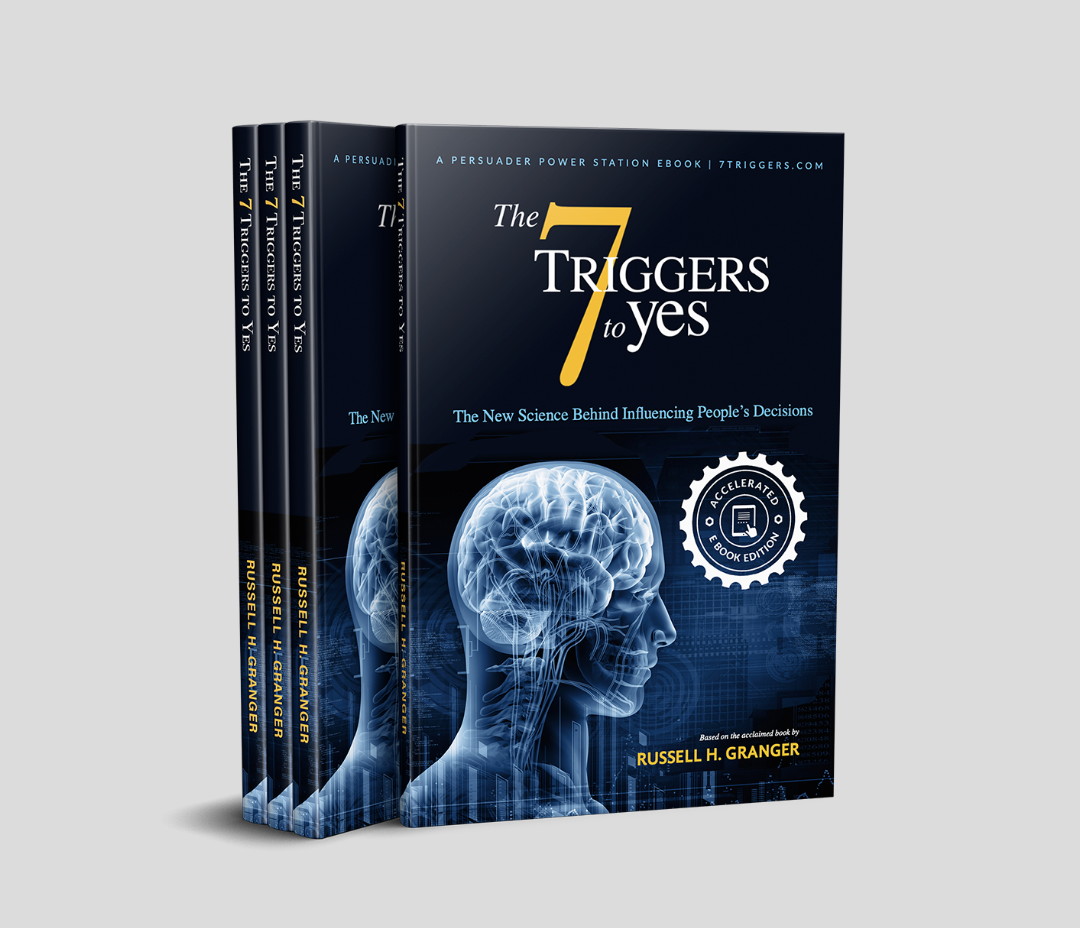
40-Page Executive Summary eBook Download
Review the seven core principles in a concise, 40-page overview of the original book. See how the triggers influence decisions, recognize where you may already use them, and consider their potential application in your business.
Just the basics.
Emailed link for instant access

Original Edition eBook or Audiobook Download
Explore the original published framework through detailed explanations and examples centered primarily on sales. Understand each trigger, why it matters, and how the seven principles work together to shape the way people respond and make decisions.
A deeper dive into the framework.
Download the eBook, audiobook, or both
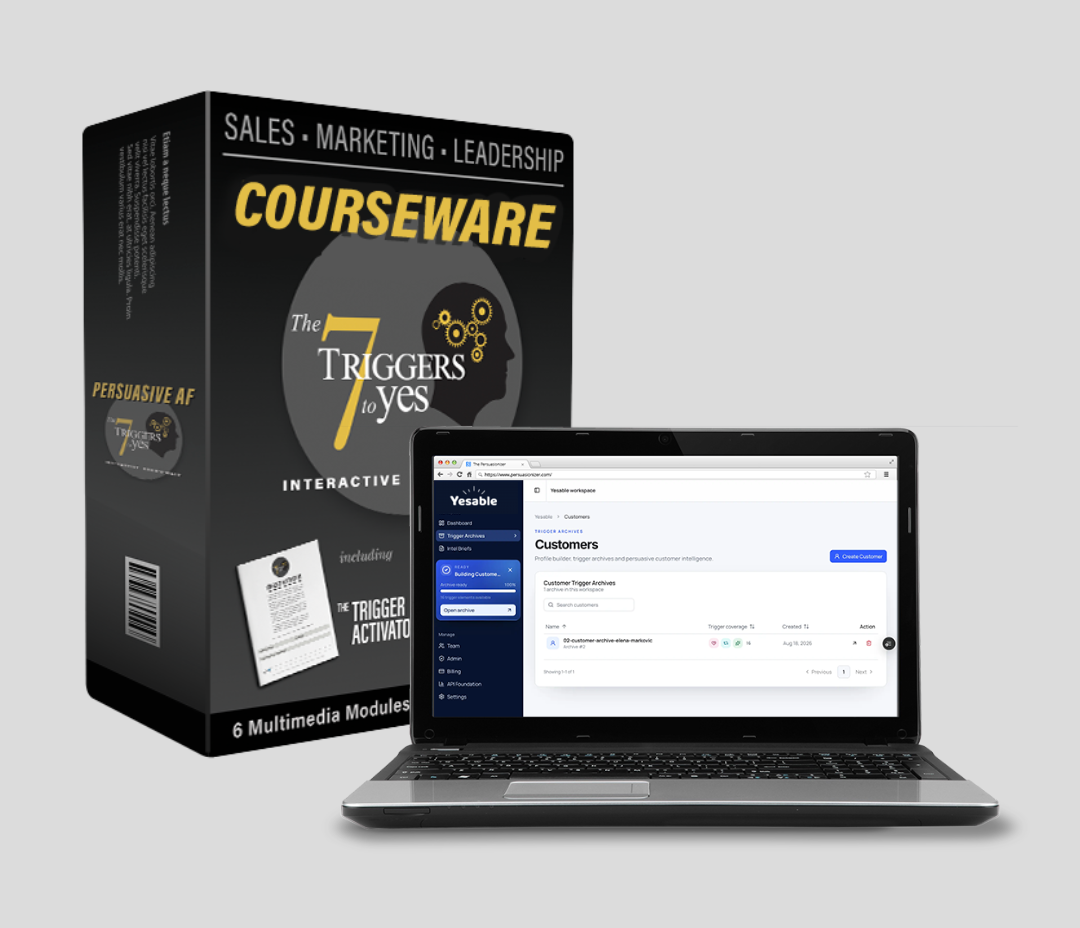
Updated Edition Video Courseware + Yesable Free Trial
Limited time beta period pricing.
Apply the refined framework through video instruction and scenarios across sales, leadership, marketing, and more. Automate its principles to generate persuasion intelligence with a Yesable account.
Make more yes part of your practice.
Video Course + Yesable Trial Details
