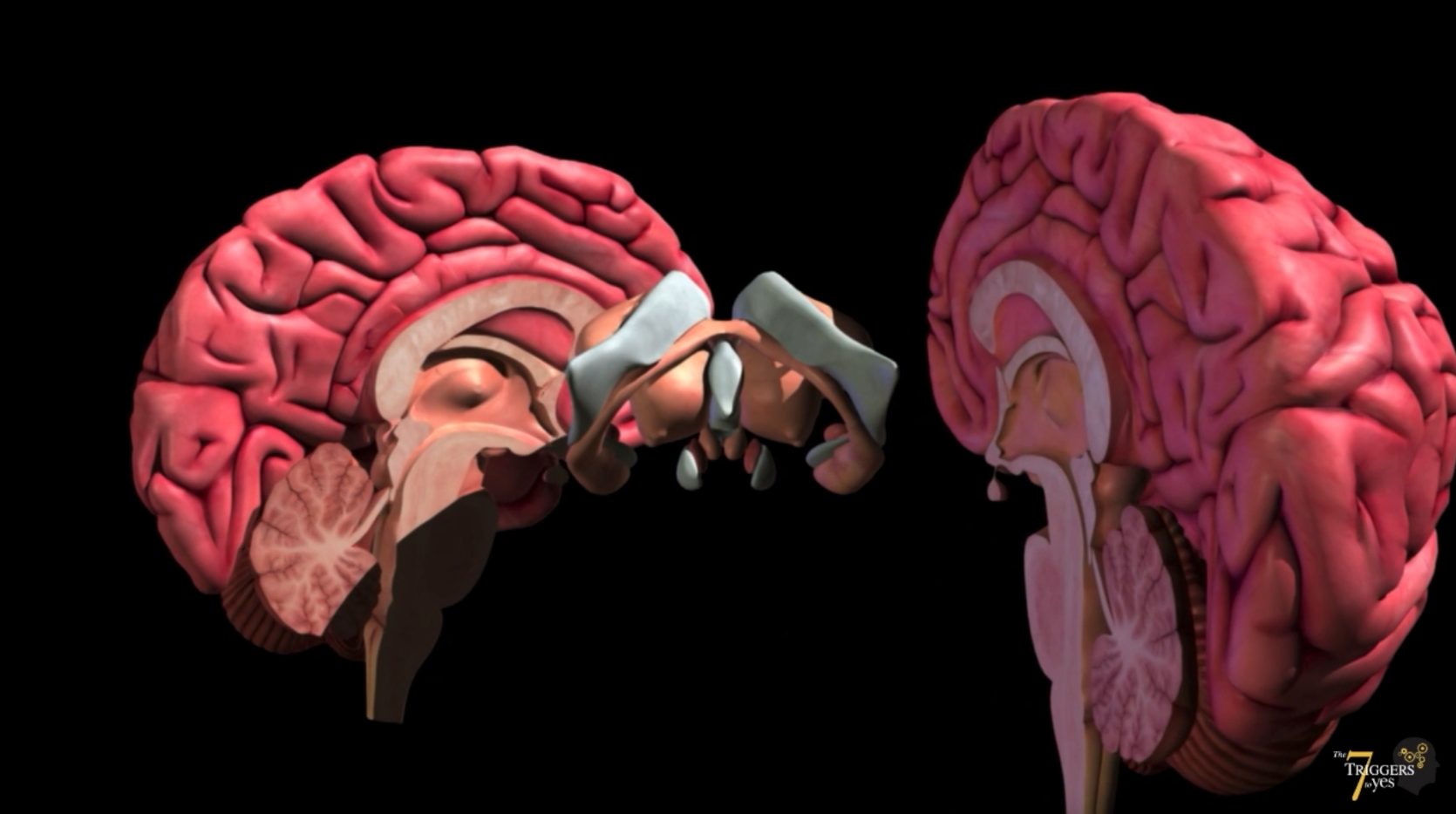
It took modern technology to reveal the true power of the primal brain, where instinct, memory, and emotion reside.
Neuroscience gave us profound insights into how decisions are made. Business is still catching up.
For most of human history, we assumed decisions were made logically; that the best argument, the strongest data, and the most thorough presentation would win. Neuroscience has shown us something fundamentally different. And for anyone whose livelihood depends on getting to yes, the implications are profound.
If you're not talking to Amy, you're not talking to the decision maker.
From the 7 Triggers courseware: understanding how the brain makes decisions, and what that means for anyone who needs to influence one.

Meet the most powerful decision-maker you've never heard of. The amygdala is ancient, almond-sized, and operates well below conscious awareness, processing the emotional signals that determine what we trust, what we want, and what we decide.
Every sales model, communication training, and presentation framework you've ever encountered is aimed primarily at the prefrontal cortex—the analytical brain.
Facts, features, data, logic, ROI. It all lands in the part of the brain that processes information.
Very little of it lands in the part of the brain that produces decisions.
That's not a minor inefficiency. It's a structural misalignment between how we've been trained to communicate and how the brain actually works. And it explains why two people with identical training, identical products, and identical opportunities can produce such dramatically different results.
The one who consistently gets to yes isn't working harder or presenting more thoroughly. They're talking to Amy G'Dala.

“Often you have to work so hard to actually apply training information in the real world. 7 Triggers does a great job of turning complex concepts into easy-to-understand messages and tools.”

Jessica Kleiman
Independent research validates the framework.
The neuroscience was known. What Russ Granger contributed was more practical: identifying the specific emotional mechanisms most critical to buying decisions, and creating a framework professionals could actually use.
With no knowledge of the framework, a large field study would arrive at precisely the same conclusions. In 2025, Corporate Visions and TruVoice asked B2B buyers directly what the losing vendor could have done differently.
The eight factors buyers identified map directly to the 7 Triggers. In several cases, the labels are nearly identical.
| Buying Factor | Trigger Alignment |
|---|---|
| Make a Case for Change | Contrast Consistency |
| Demonstrate Clear Differentiation | Contrast |
| Articulate Meaningful Value | Hope Reciprocity |
| Help Justify a Business Decision | Reason Why |
| Deliver Compelling Communications | Authority Friendship |
| Align Solutions to Needs | Primarily functional — benefits from cumulative trigger activation |
| Negotiate Creatively | Primarily functional — benefits from cumulative trigger activation |
| Resolve Concerns Responsively | Primarily functional — benefits from cumulative trigger activation |
There's more here than just alignment.
We've always known that triggers activate emotional connections. That's the science. Only, in this study, those emotional connections are called "buying factors." Just look at the words used to describe them:
meaningful · justify · compelling · creatively · responsively
Those aren't words associated with logic. Those are emotional words. Buyers are literally saying
"Help me connect with what you offer."
It's valuable to have buying objectives defined, especially when they come directly from buyers themselves. But knowing a goal isn't the same as knowing how to achieve it. No sales training program can tell a rep what, specifically, will create a meaningful connection with this buyer because that depends entirely on what that buyer values, fears, and aspires to.
That's the gap. And it's where emotional triggers make the difference.
Triggers are specific, learnable mechanisms tied to specific information about the offer and the customer. They don't just describe the emotional objectives of a selling engagement — they're built on organized intelligence that allows a seller to address those objectives naturally and meaningfully, for this offer, with this buyer, in this conversation.
If buying factors are the what, activating triggers is the how.

Dobbin Buck
“I've consumed so many books and courses on sales and persuasion that you might call me an expert on the available content. 7 Triggers is the essential. It's our go-to system, mandatory for my team.”
The 7 Triggers to Yes
Practical Guidelines Rooted in Neuroscience for More Persuasive Communications
Deceptively simple
Neuroscience-validated
Fully systematized
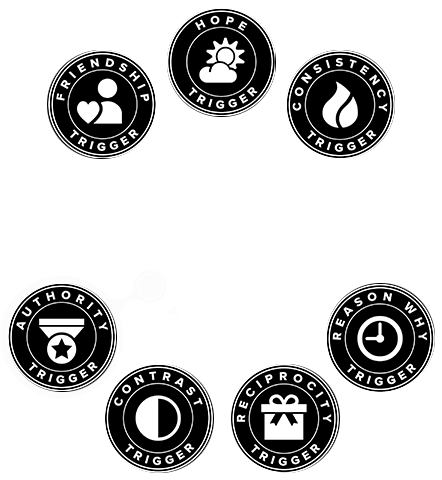
The triggers are not tactics. They're not scripts. They are the specific emotional mechanisms that activate the decision-making regions of the brain.
The Offer Triggers
These triggers are activated with intel about your products, services, ideas, or even you.
Each of these descriptions is deliberately brief—a label, not a lesson. Every trigger has its own depth, its own nuances, and its own body of research. The courseware devotes entire segments to each one.

Credibility inspires confidence. People naturally trust those they perceive as experts or leaders. Activating this trigger effectively requires judgment; when and how you do it matters.

The brain doesn't fully process ideas in isolation. It evaluates everything relative to something else. Without contrast, a feature is information. With contrast, it becomes an opinion, a conviction.

One of the oldest social contracts in human behavior. The power of this trigger compounds over time—small and large favors accumulate into a sense of obligation that nothing else can produce.

Reason Why is an emotional trigger disguised as logic. By offering a tactical rationale for belief or action, you activate a response that feels considered but is processed instinctually.
The Customer Triggers
These triggers are activated with intel about your prospect, customer, colleague, or audience.

Without this foundational trigger, the other six triggers rarely work at full power. More than just rapport, small, consistent activation ensures access to the emotional brain remains open.

Familiarity and comfort are powerful decision drivers, so people make decisions in line with their values, self-identity, and habits. This has the effect of reducing risk by managing change.

A powerful and underestimated trigger. Our culture makes us resistant to hope messages, yet spotlighting desired outcomes is one of the most reliable paths to an emotional connection with an offer.
Persuasion Intelligence
Communication Middeware for Buying Enablement
The triggers worked.
The challenge was a system
that made them work for everyone.
The strongest corporate results came when organizations reorganized their sales and marketing information according to the triggers, in advance of customer conversations. This groundwork leveled the playing field: top performers excelled, while the rest of the team came closer to them. 30% lifts in sales became common even for high-performing teams.
When we first brought the programming online, individuals were expected to do this preparation themselves. Many couldn’t, wouldn’t, or didn't realize it was needed, leading to inconsistent results unrelated to the framework. The missing piece wasn't more training, but the kind of specific, organized information we'd seen in the corporate world.
But how to close that gap? Enter AI.
Persuasion Intelligence: The identification, classification, and synthesis of offer and customer information using a proven neuroscience framework to produce an organized archive of optimized source content for every communication, conversation, campaign, and interaction.
AI automation turns information you already have into Persuasion Intelligence
Three ways to dive deeper.
Choose the one that fits where you are.

Schedule a demo and have a focused conversation about your organization, your team, your challenges and opportunities. Discover what persuasion intelligence could produce for you.

This 10-minute, simple yet revealing diagnostic measures your current activation across all 7 trigger categories, showing your natural strengths and highest-leverage opportunities.

Download a concise yet comprehensive overview of the 7 Triggers framework and the Yesable platform, designed for leaders who prefer to understand the full picture before the next conversation.