
Every Yes Depends on You
Persuasion Intelligence for Entrepreneurs
Listen to this article
The founder’s first product: the pitch.
Every early yes a founder needs comes before there’s much evidence to support it. A co-founder agrees to leave a steady job. The first hire takes a chance on your company over a safer offer. The first customer agrees to be first. An investor puts money behind a slide deck and a demo.
Each of those people is deciding about something that doesn’t fully exist yet. And the pitch is only the beginning. Once the company is running, the founder never stops persuading.
How People Actually Decide
Investors describe their process as rigorous, and it is. But look at what they say matters most.
In a survey of 885 venture capitalists by researchers from Harvard, Chicago and Stanford, more than half named the founding team as the single most important factor in their decisions. They ranked it ahead of the product, the market and the business model.
At the earliest stage, it goes further. Wharton’s Laura Huang studied angel investors and found that, for many, gut feel about the entrepreneur outweighed hard data on finances, market size, and product.
Investors call it gut feel. Neuroscience has a more precise explanation. Decisions run through the emotional parts of the brain first, and logic arrives afterward to justify what’s already been decided.
Facts inform. Logic justifies. Emotion decides.
That’s true of investors, customers, employees, and everyone else.
"Gut feel" is the emotional brain doing what it always does: deciding first, then letting the facts confirm the decision.
The 7 Triggers
If emotion decides, the practical question is: What produces it?
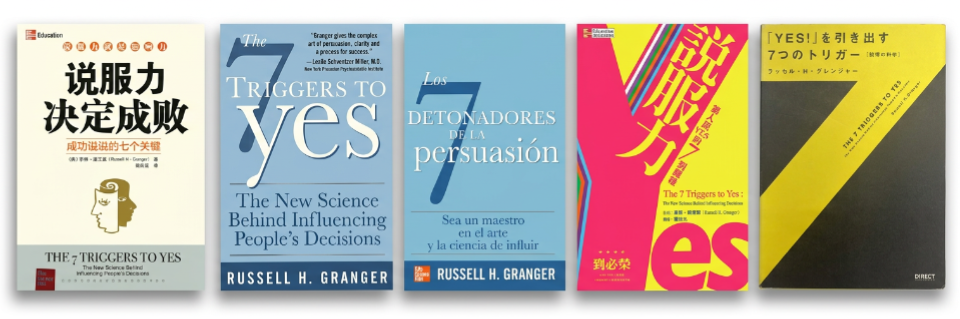
My father, Russ Granger, spent his career answering that question. Drawing on neuroscience and decades of work with sales and marketing teams, he identified seven emotional triggers that consistently move people toward a yes. He published them in The 7 Triggers to Yes™, which has since been translated into 36 languages.
Here they are at a glance:
- Authority: We trust proof: results, credentials, and people who vouch for you.
- Contrast: We judge value by comparison. Lesser options or a before-and-after.
- Reciprocity: When someone gives us something first, we want to give back.
- Reason Why: We act when there’s a specific reason to do it now.
- Friendship: We say yes more easily to people we feel connected to.
- Consistency: We favor what fits with what we already believe and do.
- Hope: What they want most
Most people already use some of these without even knowing it. The difference between persuading by instinct and persuading on purpose is knowing all seven and knowing which ones matter most to the person in front of you.
The difference between persuading by instinct and persuading on purpose is knowing all seven, and knowing which ones matter most to the person in front of you.
Every Job All at Once
The investor pitch often defines the entrepreneur, but it’s a narrow definition and a fraction of the persuasion demanded of a founder.
On any given day, the founder is also:
The Salesperson: asking customers to bet on something unproven.
The Marketer: deciding what the company says to a market that has never heard of it.
The Leader: asking a team to commit to a future the founder can describe but not guarantee.
More founders now hold all of these roles alone. Carta’s data shows solo founders started 36.3% of new companies in the first half of 2025, up from 23.7% in 2019. AI tools let one person build what once took a team. But AI tools don’t take the meetings, write the investor update, or keep a nervous hire from leaving.
(Each of these roles has its own page here: Sales, Marketing, and Leadership.)
Why This Matters Most for Founders
The 7 Triggers framework applies to everyone who needs a yes. Four things make it even more consequential for founders than for anyone else.
Three Founders, Three Kinds of Yes
WINNING INVESTORS
More than 100 investors turned down Melanie Perkins before Canva found its footing. One turning point came when investor Bill Tai didn’t fund her but invited her into his kitesurfing circle, which included the Silicon Valley investors she needed to meet. She took up the sport. Shared ground opened doors her pitch deck couldn’t. That’s the Friendship Trigger, years before Canva was worth more than $50 billion.
WINNING A CUSTOMER
Winning over a customer. Sara Blakely had a meeting with a Neiman Marcus buyer and a product nobody had heard of. Instead of describing Spanx, she took the buyer to the ladies’ room and showed her the difference in person: same outfit, before and after. That’s the Contrast Trigger in its purest form. Spanx went on the shelves.
HOLDING A TEAM TOGETHER
In May 2020, with the pandemic wiping out most of Airbnb’s business, Brian Chesky laid off about a quarter of the company, roughly 1,900 people. His letter to employees explained in detail how the decision was made. It treated departing employees with visible care, through extended severance, a year of health coverage, and help finding new jobs. And it recommitted everyone who stayed to the company’s purpose. The letter was widely held up as a model of leadership communication. That’s Reason Why, Reciprocity and Hope triggers working together. Airbnb went public that December.
None of the three won on information alone. Each one gave the other person what their brain needed to decide.
The 7 Triggers With the People You Need
Every founder needs a yes from four groups, and each responds most to different triggers:
Investors are betting on a future. They respond to a compelling picture of where this is going (Hope), evidence that you can get there (Authority), and a clear answer to “why now?” (Reason Why).
Customers are taking a risk by going first. They respond to a clear picture of what changes for them (Contrast), something valuable before they commit (Reciprocity), and an offer that fits how they already work (Consistency).
Your team is trading security for possibility. They respond to what they’ll build and become (Hope) and to building it with you (Friendship).
The market has never heard of you. It responds to what makes you different (Contrast) and to proof you’re worth trusting (Authority).
I Was That Founder
By the time I started my own agency, I had held leadership roles at IBM and BBDO, co-founded one of the world’s first digital agencies, and developed sales training programs for major companies. I had the background, the credentials, and the experience.
I still couldn’t land the anchor client the agency needed to get off the ground.
My father sat me down with a draft of what would become The 7 Triggers to Yes and walked me through the neuroscience. Then I looked at my own pitches. They were full of facts and data, and I was consciously activating one or two of the triggers at most. I knew the others. I just hadn’t organized what I said around them.
I rebuilt my approach around all seven, and landed the anchor account within weeks. After a year of trying. Not only that, I won every one of the next five accounts I pursued that first year. I didn’t work harder. I communicated more intelligently.
What Persuasion Intelligence Does
What I did by hand back then, with a manuscript and a lot of rewriting, is what persuasion intelligence now does systematically.
Most of what you need to persuade someone, you already know: about your company, and about the person you’re talking to. The trouble is that it’s scattered across your head, your notes, your pitch deck, and your inbox. When the conversation comes, you reach for whatever’s closest, and that’s usually facts and features.
Persuasion intelligence means organizing what you know around the 7 triggers, so that before any conversation you know which points will matter most to this person. Yesable, the platform we built on the framework, does that organizing in minutes. That means you walk into every conversation knowing what to say, whether it’s an investor meeting, a sales call, or an all-hands.
Belief Comes First
In the early days, there isn’t much to point to: no long track record, little revenue, a product still taking shape. Yet investors invest, customers buy, partners sign on, vendors extend terms, and people leave steady jobs to join you. None of them is deciding based on what you’ve built. They’re deciding based on what they believe about you and where you’re going.
Every one of those decisions will be made before you can prove anything. Give each of them what they need to say yes.
Put the 7 Triggers to Work for You
Nothing mysterious, no magic bullets. Seven principles grounded in neuroscience, refined through field experience, and applied to the decisions you want to influence.
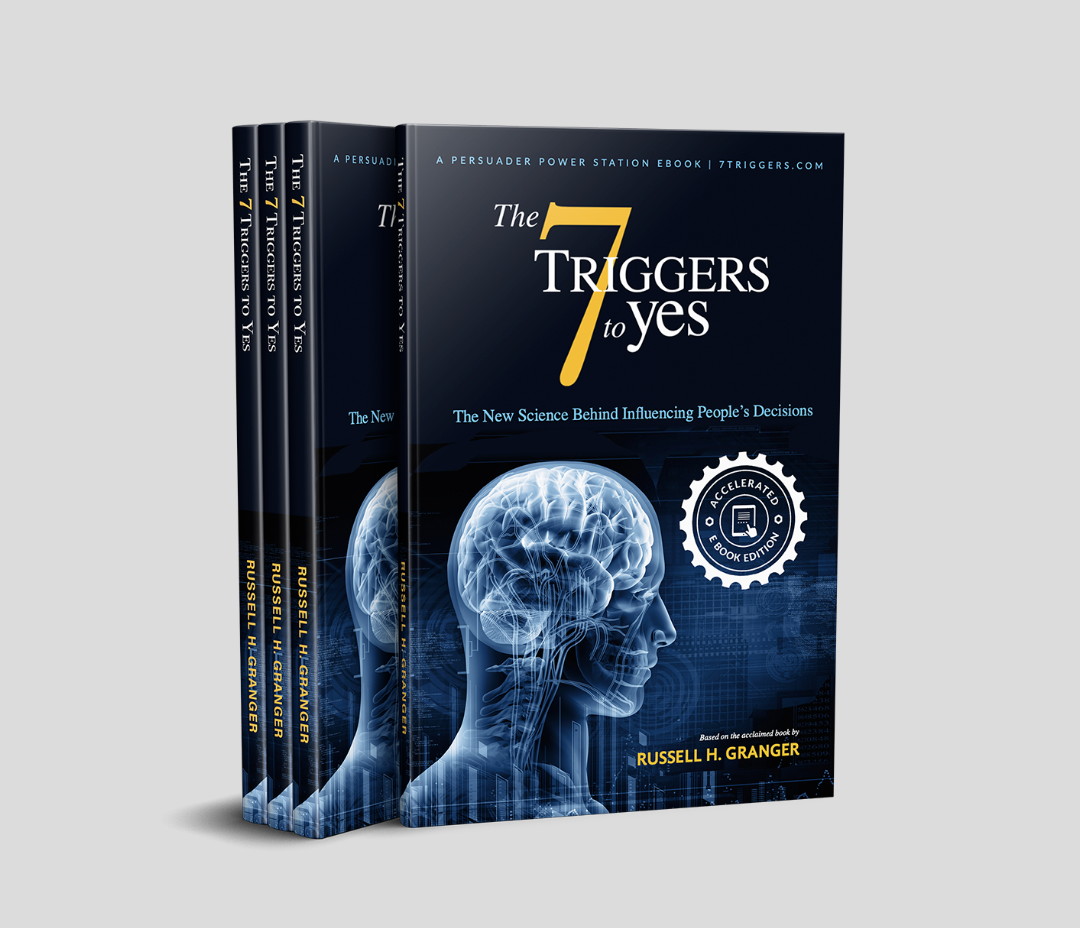
40-Page Executive Summary eBook Download
Review the seven core principles in a concise, 40-page overview of the original book. See how the triggers influence decisions, recognize where you may already use them, and consider their potential application in your business.
Just the basics.
Emailed link for instant access

Original Edition eBook or Audiobook Download
Explore the original published framework through detailed explanations and examples centered primarily on sales. Understand each trigger, why it matters, and how the seven principles work together to shape the way people respond and make decisions.
A deeper dive into the framework.
Download the eBook, audiobook, or both
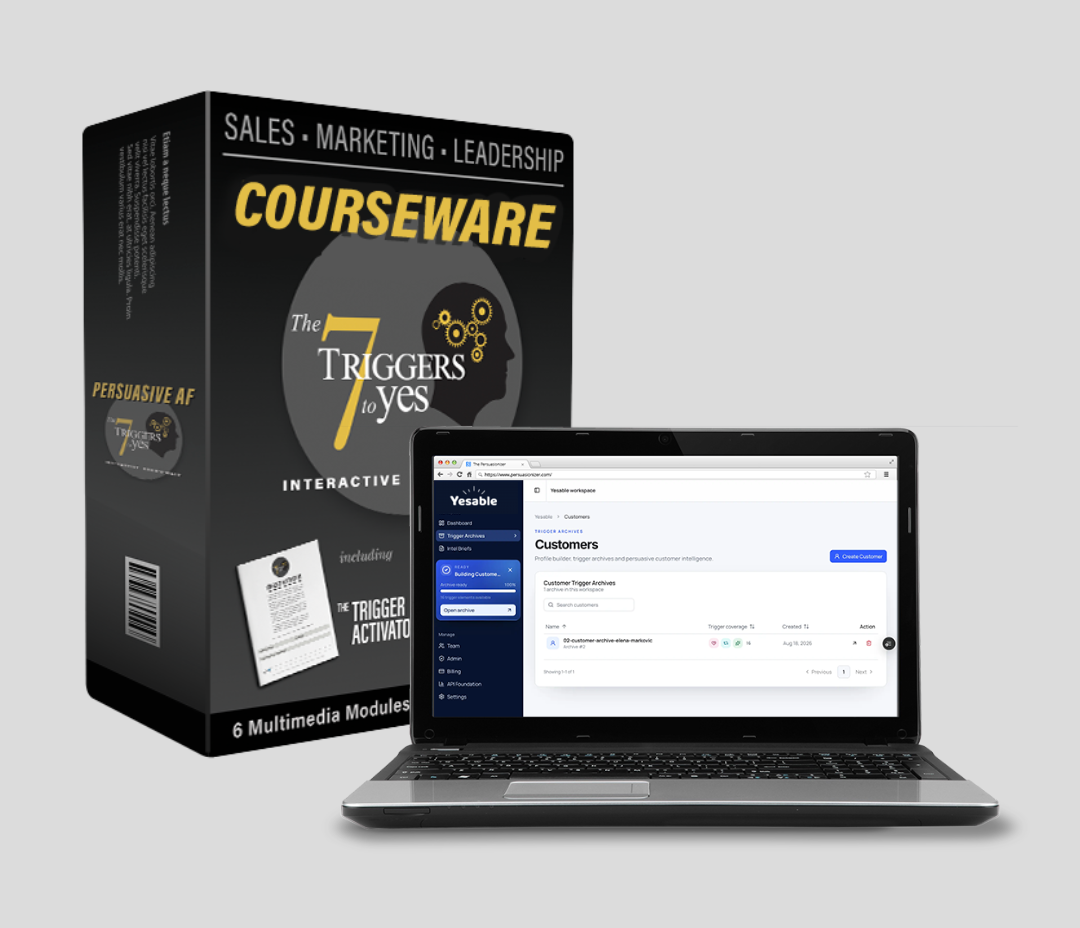
Updated Edition Video Courseware + Yesable Free Trial
Limited time beta period pricing.
Apply the refined framework through video instruction and scenarios across sales, leadership, marketing, and more. Automate its principles to generate persuasion intelligence with a Yesable account.
Make more yes part of your practice.
Video Course + Yesable Trial Details
