
The Question Your Brief Never Asks
Persuasion Intelligence for Marketers
Listen to this article
Every brief says what to make. Almost none say what will make the audience decide to click, visit, or buy.
That gap used to be survivable. Making content was slow and expensive, so the work itself differentiated you. Not anymore. According to HubSpot’s 2026 State of Marketing report
- 80% of marketers now use AI to create content.
In HubSpot’s companion survey of more than 1,700 marketers
- over half said content has become so easy to make that it’s less effective overall.
- A similar share said they struggle to stand out in a market saturated with AI output.
When everyone can generate content, generating it stops being an advantage. The advantage moves upstream, to knowing what to say before anything gets made.
That has always been the weakest point in most marketing, and it’s the question the brief typically skips.
The Evidence Was Always There
The most rigorous effectiveness research in marketing has pointed the same way for years. Les Binet and Peter Field analyzed 880 campaigns in the IPA effectiveness databank. Emotional campaigns outperformed rational ones over the long term on sales, market share, and penetration. Rational strategies produced the weakest profit returns.
B2B is no exception. CEB’s research with Google surveyed about 3,000 B2B buyers. It found that personal value, meaning what a purchase does for the buyer as a person, had roughly twice the impact of business value. Buyers who saw personal value were three times as likely to buy.
Yet the work has drifted the other way. Orlando Wood’s 2019 study for the IPA, Lemon, traced thirty years of television advertising. He found a steady loss of the elements most associated with brand growth, replaced by flatter, more literal communication.
Facts inform. Logic justifies. Emotion decides.
Even a fact intended to be impressive can backfire. A 2024 Washington State University study found that simply including the words “artificial intelligence” in a product description lowered purchase intent because it reduced buyers’ emotional trust. The effect was strongest for higher-risk purchases. The feature was real. Trust wasn’t there, and trust decided.
The more complex the offer, the faster the communication slides toward an overload of facts and features, aimed at everything except the part of the brain that makes the decision.
Between the Brand Platform and the Brief
Most marketers have tools for both ends of the job. The brand platform defines who the brand is: identity, values, voice. The creative brief defines what to make. Almost no one has a structured answer to the question in between:
Which messages will reliably move this customer toward a decision?
Usually the answer depends on one strategist’s judgment on a given day. Sometimes that judgment is brilliant. It’s rarely repeatable.
Persuasion intelligence is the missing layer between what you know about your offer and your audience, and what you actually say.
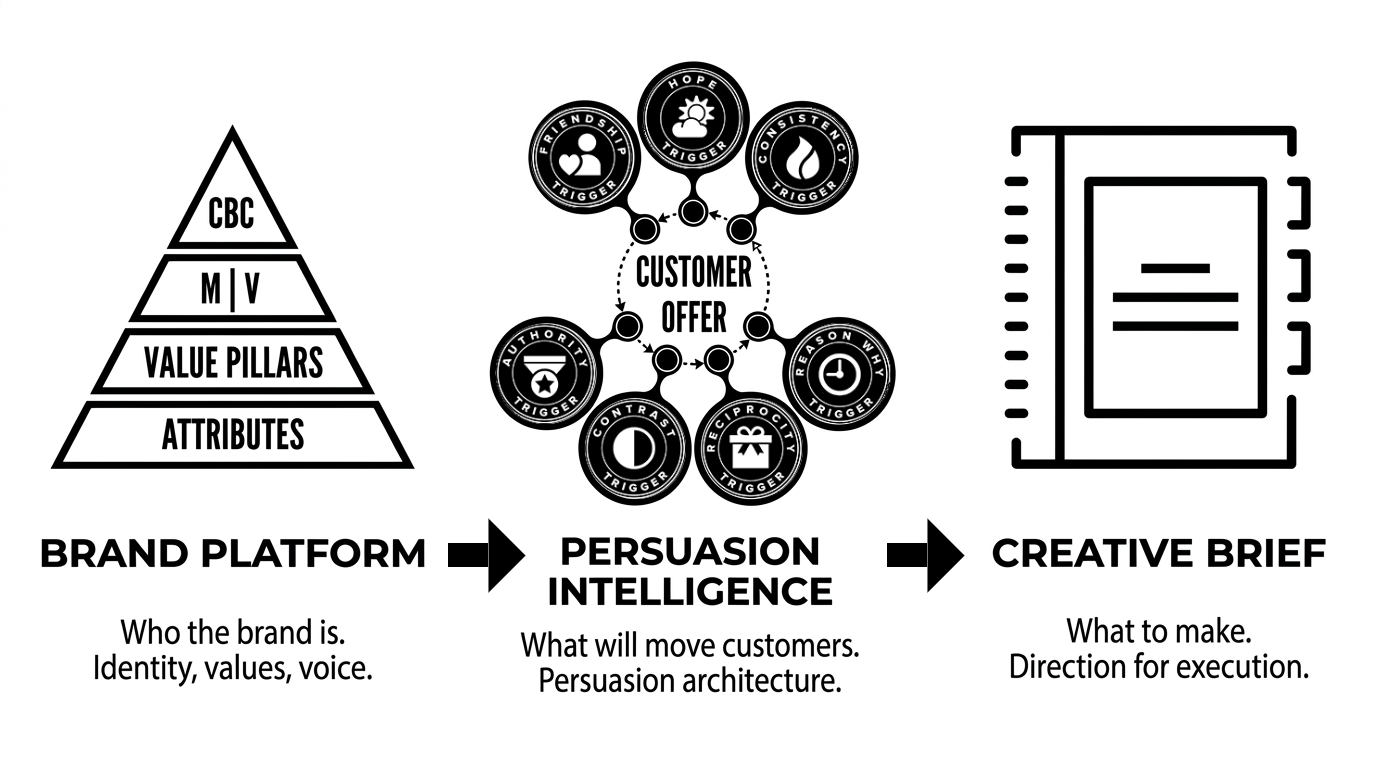
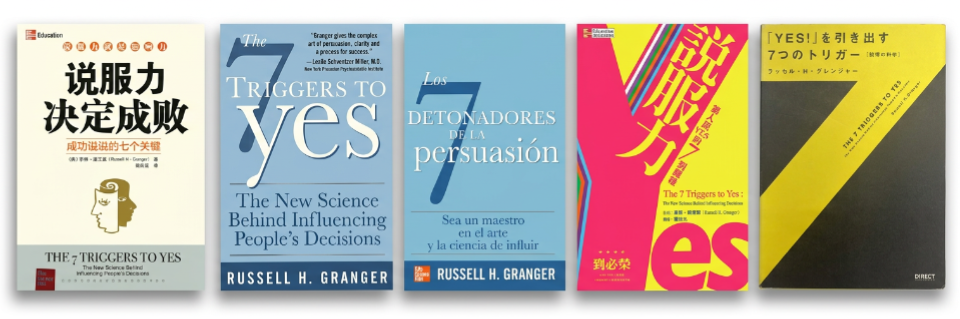
The 7 Triggers to Yes gives that layer its structure. My father, Russ Granger, developed the framework, and McGraw-Hill published it in 36 languages. It identifies seven emotional drivers rooted in how people decide, not in channel behavior or trends.
Each trigger is simple enough to grasp in a few words and extensive enough to fill a chapter, which is what each one gets in the book. Here they are at a glance.
Four triggers come from the offer:
- Authority: praise & proof
- Contrast: comparison with alternatives
- Reciprocity: value given first
- Reason Why: incentive to act now
Three triggers come from the audience:
- Friendship: shared ground
- Consistency: what they already believe and do
- Hope: what they want most
The triggers aren’t secrets, and most experienced marketers recognize them. What gets underestimated is how much they accomplish both individually and especially in combination, how often a single campaign fails to activate even one, and how seldom they activate more than two or three.
Sorting an offer and an audience into the framework was always the heavy lift. Yesable now does that in minutes. The strategy is engineered. The creative work stays yours.
What Changes
For solo professionals, this delivers leadership-level, R&D-style preparation in minutes. For a team or agency, it gives every contributor more focused persuasive power.

Proof at Scale
AbbVie built the framework into Humira’s sales and marketing, and it was then third in its category. Humira beat projections by 27% in its first year after the program launched and within five years became the world’s best-selling and most profitable prescription drug. Jim Smith, AbbVie’s former national sales director, called it “our most useful marketing and sales resource ever.”
A small biotech company had captured the easy wins in its market and then stalled. After adopting the 7 Triggers methodology, it grew sales another 34% in under a year and was later acquired for $800 million.
Shift the application of AI from creative execution to persuasion intelligence.
A Personal Note
I held leadership roles at IBM Global Services and BBDO and co-founded one of the first digital agencies. When I started my own agency, I still couldn’t land an anchor client. My pitches were full of facts and data and almost empty of triggers. Once I rebuilt them around the framework, I landed the anchor account within weeks.
Use AI Where It Counts
Marketers who use AI only to produce more content are competing on volume, against everyone. Marketers who use it to understand what moves their audience will make better work, and less of it will go to waste.
Your audience doesn’t need more content. It needs a reason to decide.
Put the 7 Triggers to Work for You
Nothing mysterious, no magic bullets. Seven principles grounded in neuroscience, refined through field experience, and applied to the decisions you want to influence.
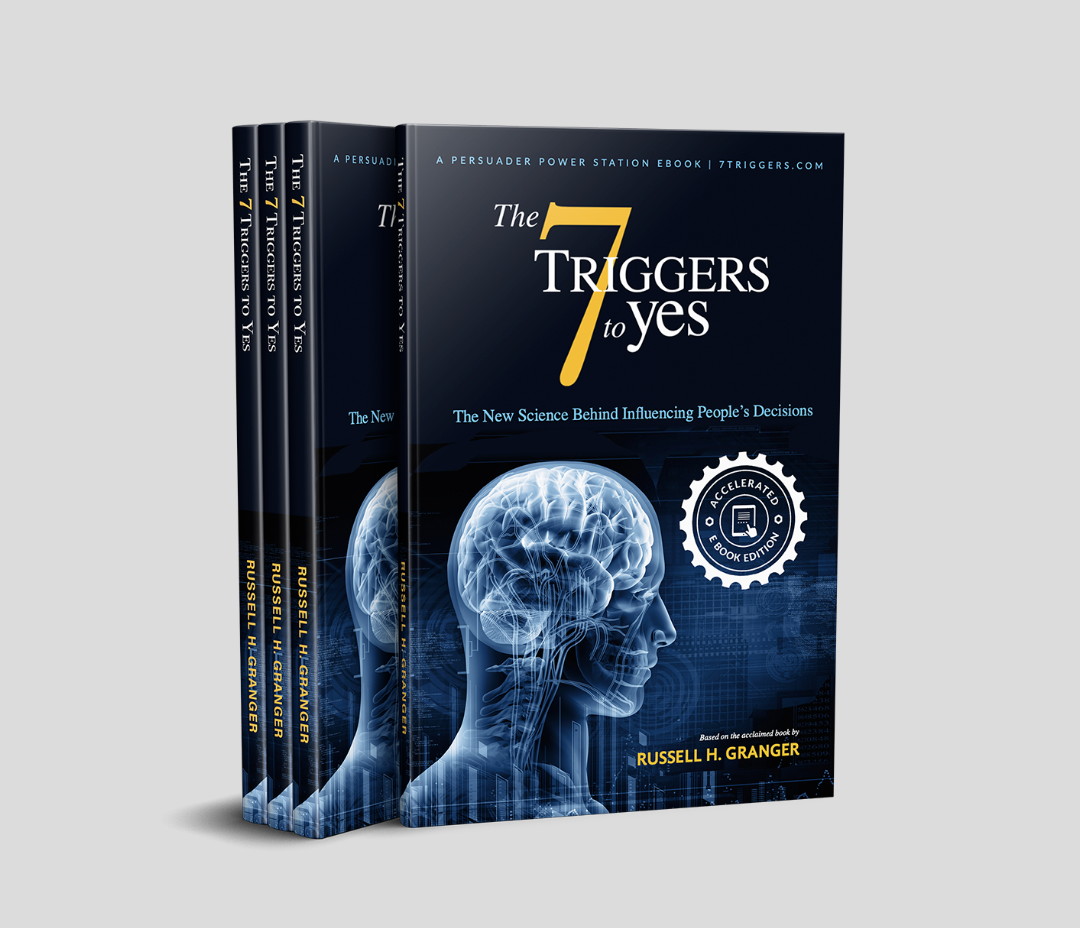
40-Page Executive Summary eBook Download
Review the seven core principles in a concise, 40-page overview of the original book. See how the triggers influence decisions, recognize where you may already use them, and consider their potential application in your business.
Just the basics.
Emailed link for instant access

Original Edition eBook or Audiobook Download
Explore the original published framework through detailed explanations and examples centered primarily on sales. Understand each trigger, why it matters, and how the seven principles work together to shape the way people respond and make decisions.
A deeper dive into the framework.
Download the eBook, audiobook, or both
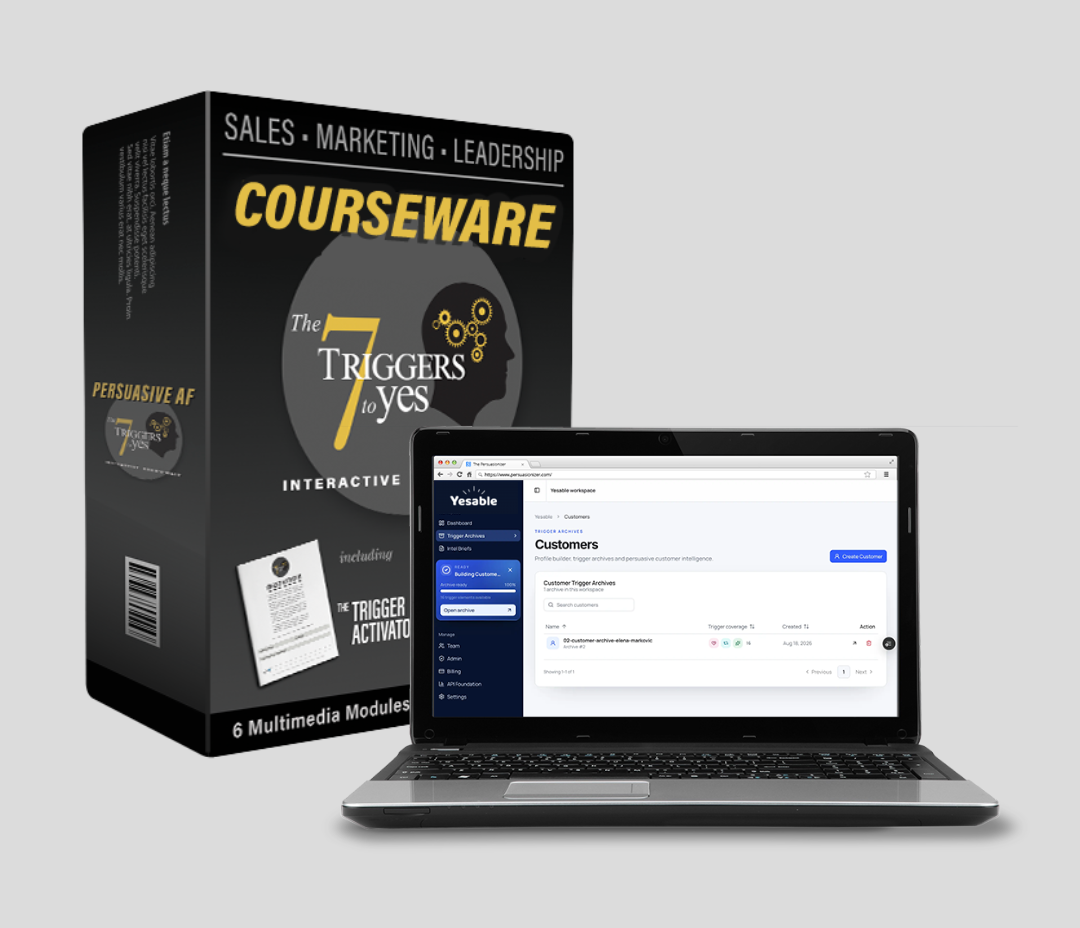
Updated Edition Video Courseware + Yesable Free Trial
Limited time beta period pricing.
Apply the refined framework through video instruction and scenarios across sales, leadership, marketing, and more. Automate its principles to generate persuasion intelligence with a Yesable account.
Make more yes part of your practice.
Video Course + Yesable Trial Details
